Wednesday, October 30, 2019

Happy Halloween

Image result for halloween


Chapter Packet is due on Monday, November 4, 2019.
Test on Tuesday, November 5, 2019.

We will discuss the enzyme lab and prepare for the permeability lab tomorrow.


In addition, I will share with you information on:
1) Robotic Pills Replacing Injections
2) Vitamin Size Cameras to Reach Every Part of the Gut.


 Below is a video link with the details of what happens during Water Poisoning.  It is based on the real  case of the "Hold Your Wee for a Wii" story.  This video explains in details what happens inside the body. It also explains how the condition can be treated.


Video Link:  Water Poisoning

Tuesday, October 29, 2019

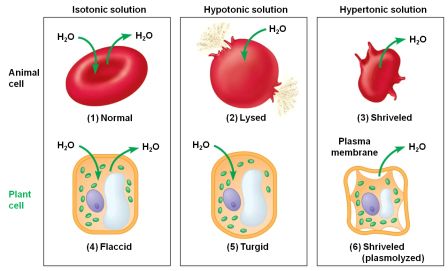
Tonicity: Isotonic, Hypertonic, and Hypotonic Solutions

You will take notes and have a discussion on the topic of diffusion and osmosis..

The relative concentration of solutes dissolved in an aqueous solution which determines the extent and direction of flow of water.

Image result for youtube showing osmosis


MEMBRANE SEPARATES TWO SOLUTIONS WITH DIFFERENT SUGAR CONCENTRATIONS. WATER MOLECULES CAN PASS THROUGH THE MEMBRANE, BUT SUGAR MOLECULES CANNOT.


Isotonic, Hypotonic, and Hypertonic


CLICK ON THE LINKS BELOW TO VIEW REAL LIFE EXAMPLE OF WATER RUSHING INTO THE CELLS, THUS CAUSING WATER POISONING.


Court Settlement for the Water Poisoning Death


WATER INTOXICATION, ALSO KNOWN AS WATER POISONING, OVERHYDRATION, OR WATER TOXEMIA IS A POTENTIALLY FATAL DISTURBANCE IN BRAIN FUNCTIONS THAT RESULTS WHEN THE NORMAL BALANCE OF ELECTROLYTES IN THE BODY IS PUSHED OUTSIDE SAFE LIMITS BY EXCESSIVE WATER INTAKE.  

Endurance sports

Marathon runners are susceptible to water intoxication if they drink too much while running. This is caused when sodium levels drop below 135 μmol/L when athletes consume large amounts of fluid. This has been noted to be the result of the encouragement of excessive fluid replacement by various guidelines. This has largely been identified in marathon runners as a dilutional hyponatremia.[5] A study conducted on participants of the 2002 Boston Marathon found that thirteen percent finished the race with hyponatremia. The study concluded that the strongest predictor of hyponatremia ( low sodium levels in the blood) was weight gain while racing (over-hydration), and hyponatremia was just as likely to occur in runners who chose sports drinks as those who chose water.[5] Medical personnel at marathon events are trained to suspect water intoxication immediately when runners collapse or show signs of confusion.

The information above explaining water intoxication was copied from Wikipedia


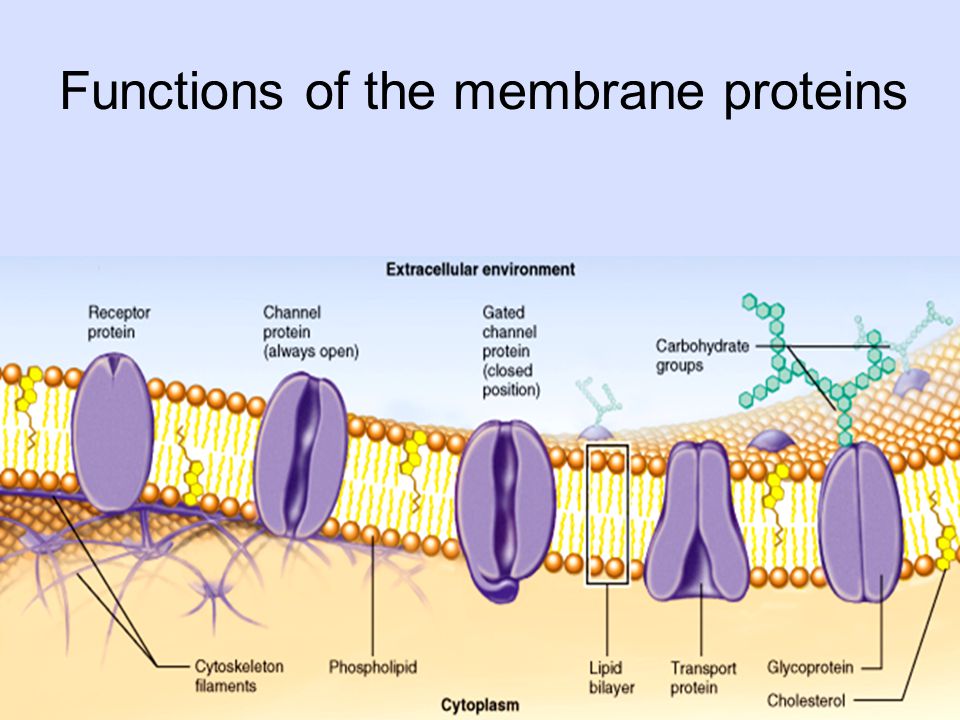
The Plasma Membrane of Eukaryotic Cells

The plasma membrane consist of a double layer of fat (phospholipid bilayer) with embedded proteins.  The membrane controls the flow in and out of the cell.

Image result for plasma membrane

Functions of the membrane proteins:
1) Enzymatic
2) Cell Signaling
3) Attachment to the cytoskeleton and extracelluar matrix
4) Transport
6) Intercellular joining.

Image result for phospholipid bilayer

Friday, October 25, 2019

Enzyme Activity Lab

You will work in groups of 4 to examine the effects of temperature on enzymes.  The enzyme used will be catalase, which is present in most cells and found in high concentrations in liver and blood cells. You will examine the decomposition of hydrogen peroxide by the enzyme.

Catalase promotes the decomposition of hydrogen peroxide in the following reaction:
                Image result for equation hydrogen peroxide decomposition

Your lab reports will be due at the end of the period.

Thursday, October 24, 2019

Cofactors and Coenzymes

Many enzymes require non-protein substances to function. Without them the enzymes would not work efficiently.  There are two types of these enzyme helpers:

 1) Cofactor: inorganic molecules, minerals, usually metal ions. For instance magnesium is important in reactions where a phosphate group is transferred. One example of this is reversible reaction of ATP.
These cofactors can turn enzymes on and off or modify the rate at which enzymes work. Iron is another example.  Iron is an integral part of hemoglobin's ability to transport oxygen,

2) Coenzymes: organic compounds like vitamins. Coenzymes bind to specific site on a protein molecule and provides chemical functions that a protein alone cannot provide.  You body can make the necessary enzymes, but not the necessary minerals and vitamins which must be included in the diet.
 
Enzyme Inhibitors:
Image result for competitive inhibition

Enzymes: Biological Catalysts

Remember that enzymes usually end in ase; catalase, sucrase. 

The enormous of biochemical reactions occurring within cells is regulated by enzymes.  Enzymes speed up chemical reactions, as well as control the rate at which reactions occur.  They are globular protein molecules manufactured by each cell.  More than 2000 enzymes have been recognized based on the chemical reactions they catalyze.  All of them are structurally different.
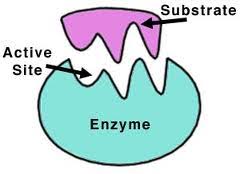

Image result for enzymeAn enzyme recognizes a specific molecule called a substrate and binds to it.  Some enzymes are so specific they only act on one substrate, while others can act on a class of substrate.

Enzymes can bring about changes to molecule to which it binds. The change usually involves the forming or breaking of a covalent chemical bond.  Enzymes may split the substrate into two pieces, may add a chemical side group to the molecule, or may simply rearrange the bonds in the substrate.


Image result for energy of activation
 Enzymes lower the activation energy by 1) providing a medium that is more favorable than the surrounding one. 2) By bringing the reactant into close contact. 3) They might add or remove a proton from the substrate , strain the substrate molecule's bond, or even form temporary covalent bond between the substrate and some part of the enzyme itself.